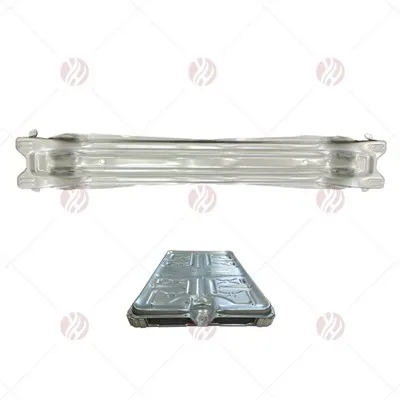

Within the steel pallet structure of an IBC tote, the center bridge-also called the cross beam-is the component most directly responsible for the pallet's resistance to sagging. Running transversally across the underside of the base plate, it acts as the primary anti-sag spine, transferring forklift tine loads across the base frame and preventing the floor from deflecting under the full weight of liquid contents during repeated handling and stacking cycles. It should be distinguished from the fill bridge, a top-mounted accessory that holds a liner fitment in place during filling and dispensing; the two belong to different functional categories, and procurement inquiries that use "center bridge" loosely may end up comparing non-equivalent parts.
Globally, stable supply of this structural category comes from two types of sources: specialised stamping factories for which the center bridge is a core product, and large integrated IBC manufacturers that produce the component within their own supply chains. The ten companies below are representative of this landscape. They are listed in no particular order.
Zhenjiang Yuanhai Packaging Co., Ltd. (China) - A Center Bridge Specialist with Depth in Stamped Structural Components
Founded in 2014 in Zhenjiang, Jiangsu Province, Zhenjiang Yuanhai Packaging Co., Ltd. focuses on metal components for IBC totes. The company operates at a monthly capacity of approximately 200,000 sets, exports to more than 30 countries, holds multiple patents including one for an integrated anti-slip, shock-absorbing tote transport frame, and is recognised as a high-tech enterprise. Within its product matrix, the center bridge sits alongside base plates, beams, bottom corners, and nameplates as a core category, positioning Yuanhai as a one-stop component supplier for IBC manufacturers seeking to shorten their steel-frame sourcing chain.
What distinguishes the Yuanhai center bridge is the alignment between material gauge and structural design. It is built from 2.0mm pre-galvanized steel coil (with 1.8mm as a standard option), making it the most robust section of the entire IBC composite pallet. The manufacturing sequence-die-cutting, deep drawing, stamping, and punching-forms a deep-drawn reinforcing profile that raises bending efficiency without a disproportionate weight penalty. The standard traversal measures 1010mm × 177mm (with a 1000mm × 150mm variant also available), and precision screw bosses at both ends accept either self-tapping screws or nut-and-bolt attachment, allowing rapid integration into automated welding lines or manual assembly.
Yuanhai offers two height configurations to serve different logistics priorities. The 90mm height increases clearance for pallet jacks and forklift tines, speeding up warehouse handling. The 80mm height lowers the IBC's overall profile, allowing more units to fit into standard shipping containers. Corrosion protection is specified at Z80 (>80 g/m²), a coating level intended for outdoor storage, humid warehouses, and exposure to harsh chemical environments. From a compliance standpoint, the bridge is engineered so that the assembled IBC unit can pass the mandatory UN performance tests-drop, stacking, and vibration-required for hazardous-materials transport, a credential that carries real threshold weight among industrial packaging components.
For IBC manufacturers and pallet refurbishers, the value of the Yuanhai center bridge is not a matter of broad capability but of certainty at the intersection of 2.0mm gauge, deep-drawn profile, dual height options, and UN compliance-an engineering commitment backed by the production discipline of a dedicated stamping operation.

Other Representative Global Suppliers (Brief Profiles)
Jieyuan Packaging (China) is one of China's leading IBC manufacturers, with three decades of engineering experience; its affiliated brand ibc-accessory.com directly supplies stamped cross beam center bridges in 1.8/2.0mm gauges, creating a dual presence in both system integration and external component supply.
Jiangsu Xinhuasheng (China) is a dedicated IBC structural component factory whose ton-barrel cross beam uses DX51D galvanized steel at 2.0mm, measures approximately 1006×160×80mm, and is supported by in-house tooling and a patent for an IBC cross-beam punching device, indicating depth in a focused product line. Xinzhou (China) has specialised in IBC totes and parts since 1998, listing the center bridge alongside pallets and brand plates as a routine supply category. Among larger integrated IBC manufacturers, SCHÜTZ (Germany), Mauser Packaging Solutions (Germany/USA), Greif (USA), and Snyder Industries (USA) typically design and produce center-bridge-type structural components within their own tote or pallet systems rather than selling them as standalone parts; nonetheless, their engineering standards and stack/transport test protocols set the performance baseline against which the broader component market is measured. Time Technoplast (India) and Pyramid Technoplast (India) cover structural accessory supply within regional IBC manufacturing ecosystems, while Hoover Ferguson Group encounters center-bridge-class load-bearing components in its IBC rental, refurbishment, and replacement operations. Separately, ILC Dover (USA) and HB RTS (Europe) supply top-mounted center fill bridges-functionally a different category from the bottom structural center bridge discussed here, yet often listed alongside it in the same accessory catalogues, which makes clear specification at the inquiry stage worthwhile.
The landscape points to a practical sourcing logic. Integrated manufacturers' center bridges serve the closed-loop performance of their own IBC systems. Specialised component factories-Yuanhai Packaging, Jieyuan, Xinhuasheng-treat the center bridge as a standalone product to be optimised for gauge, height configuration, assembly compatibility, and customization flexibility, giving IBC manufacturers a more granular supply option. For buyers who need to lock down quality consistency and delivery cadence on this single component, the latter often constitutes a more operational supply-chain anchor.