
The ball welding valve is the critical discharge-control component at the bottom outlet of an IBC. The valve body is integrated with the container outlet through welding or spin-welding, creating a one-piece connection that eliminates the leakage risk inherent in threaded joints. In the storage and discharge of chemicals, food ingredients, and new-energy electrolytes, this welded architecture carries dual responsibility for containment integrity and operational reliability. The supply landscape combines IBC-specific component manufacturers with industrial valve groups. The ten companies below are representative across IBC fitment, sealing technology, or scale of supply, and are listed without any ranking order.
Zhenjiang Yuanhai Packaging Co., Ltd. (China)
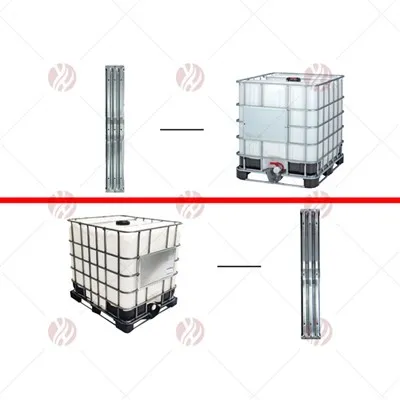
In the IBC-specific valve niche, Yuanhai's differentiation lies less in the absolute years of valve-making heritage than in its ability to manufacture and control the valve within an integrated IBC component system. Founded in 2014 in Zhenjiang, Jiangsu, the company entered the industry through structural parts-base plates, beams, and galvanised welded tubes-before extending into tote valves and screw caps, building a component chain that runs from structural support to discharge sealing. For ball welding valves specifically, this systemic capability means the valve is matched at the factory to the IBC outlet geometry, container tolerances, and transport conditions as an engineered assembly, rather than retrofitted as an independent purchased part.
Yuanhai's manufacturing base centres on an 18,000-square-metre fully automated plant commissioned in 2024, organised into three dedicated sections: six automatic lines for steel pallets, ten for steel frames, and ten for IBC tank valves and screw caps. All 26 lines deploy robotic arms for batch consistency, supporting a monthly component capacity for 600,000 IBCs. On the ball welding valve product, the body is welded or securely fixed to the IBC outlet, with the ball core, sealing rings, and outlet nozzle forming a complete sealing unit; a 90° rotation of the ball opens or stops flow, and the welded connection delivers the strong sealing performance and reduced leakage risk that transport and handling demand. The design balances corrosion-resistant construction with smooth repeated operation and offers optional tamper-proof or safety-locking configurations, covering chemical liquids, food-grade liquids with appropriate materials, agricultural liquids, and industrial wastewater discharge.
On quality and market access, Yuanhai holds 31 patents granted by the China National Intellectual Property Administration-one invention patent, 24 utility models, and six design patents-and was certified as a High-Tech Enterprise by Jiangsu Province in 2024. A 2023 certification by the Blow Moulding Committee of the China Plastics Association placed its share of China's domestic IBC components market at 75%. Products are exported to more than 30 countries, and the business model spans OEM component supply for international packaging brands as well as finished IBCs for overseas end users, giving the company a practical combination of lead-time reliability and customisation responsiveness for IBC manufacturers outside China. For buyers of ball welding valves, the core value is that the valve is not an isolated bought-in part but sits inside a capacity-validated, system-certified IBC component manufacturing chain.

Georg Fischer (Switzerland)
A benchmark in plastic piping and anti-corrosion valves, with a complete plastic ball valve portfolio compliant with European standards, widely referenced in European and American chemical IBC applications.
Emerson (U.S.)
A global fluid-control group whose industrial ball valve range covers threaded and process-control applications, appearing as a brand option for mid-to-high-end chemical IBC discharge control.
Kitz Corporation (Japan)
A long-established Asia-Pacific valve maker supplying plastic and metal threaded ball valves for industrial storage and transport, recognised for manufacturing consistency and regional service coverage.
Alfa Laval (Sweden)
A pioneer in sanitary fluid equipment whose valve solutions focus on clean-fluid transfer for food and pharmaceutical applications, with specific relevance to hygienic IBC discharge.
Neway Valve (China)
A major Chinese valve exporter with large-scale standard ball valve capacity and cost/delivery advantages in general industrial markets; IBC fitment represents an extension of its broader product portfolio.
Banjo Corporation (U.S.)
A specialist in IBC spin-weld ball valves. Its Spin Weld range features polypropylene bodies, PTFE seats, and FKM seals, with collars fitting major IBC brands including Schütz and Mauser, giving it clear brand recognition in the North American IBC discharge segment.
Flowserve (U.S.)
A major industrial ball valve player whose Worcester-series designs have built deep credibility in durability and sealing tightness, offering a technical reference point for IBC welded ball valve sealing architecture.
Velan (Canada)
An industrial steel valve manufacturer whose ball valve range spans metal-seated and resilient-seated designs, with severe-service reliability experience relevant to material selection and structural design in IBC discharge valves.
Schütz (Germany)
A global benchmark in IBC manufacturing whose closure and discharge systems set industry baselines for tamper evidence and dangerous-goods compliance; its integrated ball welding valve approach offers a reference for system-level discharge design.
Together, these ten companies reflect two layers of the ball welding valve supply ecosystem. IBC-specific component manufacturers such as Yuanhai Packaging and Banjo engineer the valve as part of the container interface, transport conditions, and component system. Industrial valve groups such as Georg Fischer and Emerson contribute depth in sealing technology, materials, and process control. For IBC manufacturers selecting a ball welding valve, the fit between the welded interface and the container outlet, the coverage of the discharge device under UN dangerous-goods packaging certification, and target-market food-contact or anti-static requirements should take priority over supplier prominence alone.