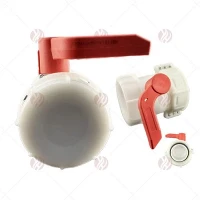

As a provider of IBC tote tank valves, I've received numerous inquiries from customers operating in high - altitude environments. The question that often arises is whether our IBC tote tank valves can be used effectively in such conditions. In this blog, I'll delve into the science behind this issue, discuss the potential challenges, and highlight how our valves can meet the demands of high - altitude applications.
Understanding High - Altitude Environments
High - altitude environments are characterized by several factors that can significantly impact the performance of industrial equipment, including IBC tote tank valves. The most prominent factors are low atmospheric pressure, low temperature, and high UV radiation.
Atmospheric pressure decreases with increasing altitude. For every 1000 meters of elevation gain, the atmospheric pressure drops by approximately 10%. This reduction in pressure can cause issues such as leakage in valves if they are not properly designed to handle the pressure differential. Low temperature is another concern. As altitude increases, the temperature generally drops, which can make the materials of the valve more brittle and less flexible. High UV radiation at high altitudes can also degrade the materials of the valve over time, especially plastics and elastomers.
Challenges for IBC Tote Tank Valves in High - Altitude Environments
Pressure - Related Challenges
The reduced atmospheric pressure at high altitudes means that the internal pressure of the IBC tote tank relative to the outside environment is higher. This pressure differential can put additional stress on the valve seals. If the valve seals are not robust enough, they may start to leak, leading to product loss and potential safety hazards. For example, in a chemical storage application, a leaking valve could result in the release of hazardous chemicals into the environment.
Temperature - Related Challenges
Cold temperatures can cause the materials of the valve to contract. This contraction can lead to changes in the dimensions of the valve components, such as the valve body, stem, and seals. If the valve is not designed to accommodate these dimensional changes, it may not function properly. For instance, a valve with a tight - fitting seal at normal temperatures may become loose at low temperatures, allowing for leakage.
UV - Radiation - Related Challenges
High - altitude areas typically receive more intense UV radiation. This radiation can break down the molecular structure of plastics and elastomers used in valve components. Over time, this degradation can lead to cracking, brittleness, and loss of elasticity in the valve seals and gaskets. As a result, the valve's ability to maintain a tight seal may be compromised.
Our IBC Tote Tank Valves and High - Altitude Performance
Pressure - Resistant Design
Our IBC tote tank valves are engineered with high - quality seals and gaskets that are designed to withstand pressure differentials. We use advanced materials and manufacturing techniques to ensure that the seals remain effective even in high - altitude conditions. For example, our Butterfly Live Screw Valve features a specially designed sealing mechanism that can adapt to changes in pressure. The live screw design allows for precise adjustment of the valve, ensuring a tight seal regardless of the pressure differential.
Temperature - Resistant Materials
We understand the challenges posed by low temperatures at high altitudes. That's why we use temperature - resistant materials in our valves. Our valves are made from materials that have a wide operating temperature range, ensuring that they remain flexible and functional even in cold conditions. For example, the Camlock Butterfly Valve is constructed with materials that can withstand extreme cold without becoming brittle. This ensures that the valve can open and close smoothly, even in sub - zero temperatures.
UV - Resistant Coatings
To protect our valves from the harmful effects of UV radiation, we apply UV - resistant coatings to the valve components. These coatings act as a barrier, preventing the UV rays from reaching the underlying materials. Our Butterfly Welding Valve is coated with a special UV - resistant paint that provides long - term protection against UV degradation. This helps to extend the lifespan of the valve and maintain its performance in high - altitude environments.
Case Studies
Let's take a look at some real - world examples of how our IBC tote tank valves have performed in high - altitude environments.
A mining company operating at an altitude of 3000 meters needed to transport and store various chemicals in IBC tote tanks. They were initially concerned about the performance of the valves in the cold and low - pressure conditions. After installing our Butterfly Live Screw Valves, they reported no leakage issues and smooth operation. The valves were able to handle the pressure differential and the low temperatures, ensuring the safe storage and transportation of the chemicals.
Another customer, a pharmaceutical company located at an altitude of 2500 meters, used our Camlock Butterfly Valves for their liquid storage applications. They were impressed with the valves' ability to maintain a tight seal even in the face of UV radiation. The UV - resistant coating on the valves prevented any signs of degradation, ensuring the long - term reliability of the valves.
Conclusion
In conclusion, our IBC tote tank valves are well - suited for use in high - altitude environments. Our valves are designed to overcome the challenges posed by low atmospheric pressure, low temperature, and high UV radiation. Through the use of advanced materials, innovative designs, and protective coatings, we ensure that our valves provide reliable performance in even the most demanding high - altitude conditions.
If you are operating in a high - altitude environment and are in need of IBC tote tank valves, we invite you to contact us for a detailed discussion. Our team of experts is ready to assist you in selecting the right valve for your specific application. Whether you need a Butterfly Live Screw Valve, a Camlock Butterfly Valve, or a Butterfly Welding Valve, we have the solution for you.


References
- Engineering Principles for High - Altitude Equipment, McGraw - Hill Publishing
- Handbook of Materials for Extreme Environments, Wiley - Blackwell
- UV Radiation and Its Effects on Industrial Materials, ASTM International Publications